Cash flow suprises
Why Many Mid-Sized Companies — Especially in Construction — Keep Facing Cash-Flow Surprises Every Month (And the 4-Week System to Fix It)
It’s the 12th of the month. The management accounts look reasonable on paper, but your bank balance tells a different story. Payroll is due soon, two major customers are late with payments, and you’re already considering whether to delay a supplier invoice or draw on the overdraft.

This scenario is all too familiar for many leaders of mid-sized companies.
Having stepped into this exact situation multiple times as an interim finance manager, I’ve seen how cash-flow surprises have become the norm rather than the exception in companies with €45M to €70M turnover. The managing director is exhausted from constant firefighting, the finance team is buried in compliance work, and decision-making suffers from limited visibility.
The good news? It doesn’t have to stay this way. In this article, I share the practical 4-week system I’ve implemented successfully across multiple assignments to bring cash visibility under control — often delivering clear improvements within four to six weeks.
The Hidden Cost of Persistent Cash-Flow Surprises
When I begin a new assignment, the same patterns usually appear:
Profit looks acceptable, but cash remains tight and unpredictable.
The team spends 8–12 days each month just assembling basic financial information.
Important decisions on hiring, investments, or supplier negotiations are delayed due to unreliable forecasts.
The owner is frequently forced to inject personal funds or provide guarantees.
Banks and financial partners demand increasingly detailed scrutiny.
In one recent €60M industrial company, poor cash visibility was costing approximately €180k–€250k annually in unnecessary interest, lost early-payment discounts, and emergency funding. Another €27M distribution business was holding €420k in excess inventory while simultaneously chasing overdue invoices — a classic working capital trap.
These issues don’t just create stress — they drain profits, slow growth, and consume leadership energy that should be focused on strategic initiatives.
Common Cash-Flow Disruptors in Project-Driven Businesses
Beyond the hidden costs, several recurring operational issues directly damage cash positions. Here are the most frequent ones I have encountered:
1. Delayed or disputed invoicing
Invoices issued 30–45 days after delivery or milestone completion, effectively financing the customer’s project.
2. Late payment excuses
“We never received the invoice” or “It hasn’t been validated by the technician” — often due to poor follow-up processes.
3. Unauthorized discounts
Customers applying rebates without proper internal approval.

4. Pressure on accounts payable
Project or production managers pushing for preferential treatment of certain suppliers outside standard processes.
5. Underuse of financial levers
Such as down-payment guarantees or requesting advance payments from customers.
6. Unbilled extras
Additional work performed outside the original contract specifications.

7. Missed price adjustments
Failing to pass on raw material price increases or indexation clauses.
Why This Pattern Persists in Mid-Sized Companies
Most companies have invested in better reporting tools, but few have updated their underlying processes and behaviours. The classic People-Process-Technology framework explains why:
- People: Weak cash culture (a sale is only complete when the cash is received), poor collaboration between finance, sales, and operations, and finance teams overloaded with bookkeeping instead of forward-looking analysis.
- Process: Inconsistent collection routines, unclear roles, long delays between delivery and invoicing, and information scattered across systems and people.
- Technology: Fragmented data sources, incomplete aging reports, missing key metrics (DSO, DPO, DIO, CCC), and limited automation.
The Hands-On 4-Week Cash-Flow Improvement System
Here is the practical playbook I use to deliver fast, sustainable results. It works across sectors, though specific adaptations are made according to industry and geographic complexity.
Build a Reliable Data Foundation
I start by creating a robust 13-week rolling cash forecast using a structured Excel template with probability weighting for receipts and payments. We pull data from accounting software, CRM, and operational systems. Within five days, the company usually has a living document that leadership can actually trust.
Build a Reliable Data Foundation
I start by creating a robust 13-week rolling cash forecast using a structured Excel template with probability weighting for receipts and payments. We pull data from accounting software, CRM, and operational systems. Within five days, the company usually has a living document that leadership can actually trust.
Build a Reliable Data Foundation
I start by creating a robust 13-week rolling cash forecast using a structured Excel template with probability weighting for receipts and payments. We pull data from accounting software, CRM, and operational systems. Within five days, the company usually has a living document that leadership can actually trust.
Build a Reliable Data Foundation
I start by creating a robust 13-week rolling cash forecast using a structured Excel template with probability weighting for receipts and payments. We pull data from accounting software, CRM, and operational systems. Within five days, the company usually has a living document that leadership can actually trust.
From Crystal ball to Crystal clear:
The CWWC 4-Layer Cash Forecast Model
One of the fastest ways to lose credibility is delivering unreliable cash forecasts. To address this, I use a practical model called CWWC (Cash Position – Will Be Cash – Would Be Cash – Could Be Cash).
The 4 essential pillars of a sustainable & reliable cash forecast.
| LIQUIDITY LAYER | REALIZATION PROBABILITY | KEY SOURCES | OWNERSHIP | TIME HORIZON |
|---|---|---|---|---|
|
CASH POSITION |
100% |
Bank Statements
Petty Cash |
Accounting
and/or
Treasury |
Now |
|
WILL BE CASH |
95% |
Aging Balance |
Accounting |
90 Days |
|
WOULD BE CASH |
80% |
Orders Back Log |
Controlling
Sales
Project Manager |
90 Days
to 180 Day |
|
COULD BE CASH |
50% |
Order Pipeline |
Strategic
Leadership
Sales Direction |
180 Day
and beyond |
(Visual 1: Before – Wide uncertain pyramid with large “Could Be Cash” section at the top)
Assumptions taken:
- This Timing would apply for a company with sales conditions from 30 to 60 days
- The realization rate is assuming the aging balance is regularly reviewed
- The realization rate for a portfolio will very much depend on the success probability applied by the sales or the project management team
This layered approach starts with high-certainty items and progressively adds elements with decreasing probability, using weighted calculations in Excel. It brings transparency and builds trust with stakeholders.
Core Components of FP&A Planning Tools
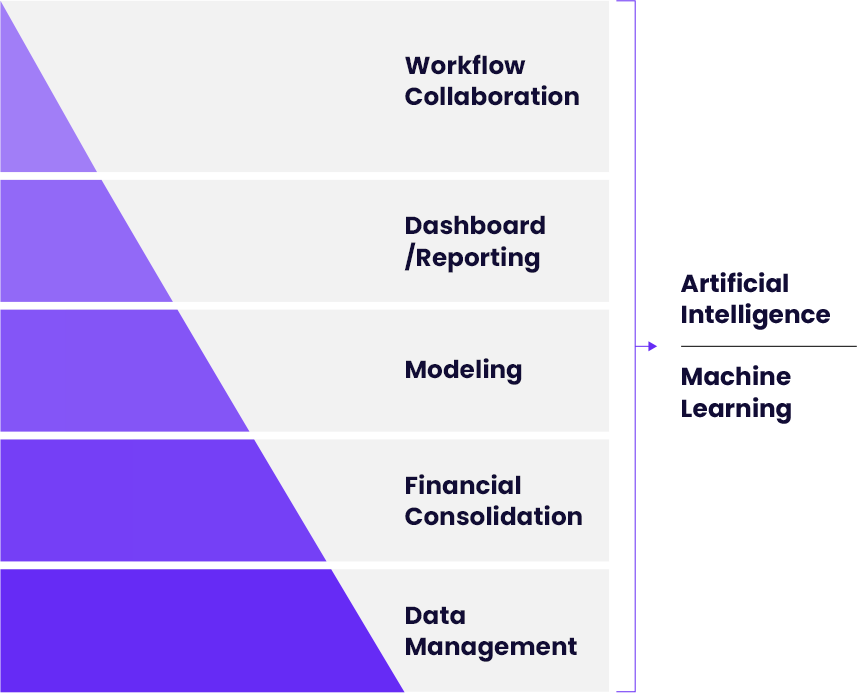
Visual 2: After – Much narrower top, stronger base after implementing disciplined processes
Actions to strengthen forecast:
Client validation checks + clear ownership
+ strict m+5 closing discipline.
Check-List of actions triggered during the month:
Cleaning of payables and receivables balance (why do we have pending credit notes or down payments)
Have we identified potential supplier payments to delay a couple of weeks just in case
Have we checked key supplier payments that could compromise a big invoice?
Do we have a clear vision on due receivables for the end of month?
How does the balance between incoming cash and disbursements look like?
Are we in a quarterly period where interests or mortgages are due?
Has Finance challenged Sales and Operations enough for a conservative forecast
How to Deliver your forecast by m+5 (Ideal delivery date)
My strong recommendation is to include in your closing schedule the following timeline for cash management:
Day m+1
Accounting closes
Cash Position
Day m+2
Accounting updates aging: Will Be Cash
Day m+3
Sales + Project Managers
validate backlog: Would Be Cash
Day m+4
Leadership reviews pipeline: Could Be Cash
Day m+5
Finance runs the weighted CWWC calculation and presents the report
Real Result – Laurent Membrez SA
We moved from four-week visibility with constant surprises to a trustworthy 16-week rolling forecast. Month-end closing improved to m+5, and accounts receivable write-offs decreased by 12%.
Take Back Control of Your Cash
Cash-flow problems in growing mid-sized companies are rarely caused by weak sales. They almost always result from insufficient visibility, outdated processes, and poor cross-functional alignment.
You don’t necessarily need a full-time CFO yet. Sometimes you just need an experienced interim finance professional who has solved this exact challenge many times before.
If this resonates with your current situation, here are two simple next steps:
Download the practical templates I use (13-week cash flow forecast and customer invoice follow-up tracker).
Book a no-obligation 20-minute call. We can review your current setup together and I’ll share 2–3 specific improvements you can implement immediately.

Ready to tackle your biggest operational challenges?
Book a no-obligation 30-minute diagnostic call and I’ll help you identify your top 3
priorities and quick wins — at no cost.