AI Task Classification Framework Finance
Finance teams are under constant pressure to deliver more with less: faster closes, clearer cash visibility, sharper forecasts, and tighter control. AI looks like the obvious answer. Yet many organisations still treat it as a technology purchase rather than a work redesign. They hire an “AI-savvy” FD or CFO and expect a rabbit to appear from a hat. The result is usually a series of disconnected pilots that never scale.
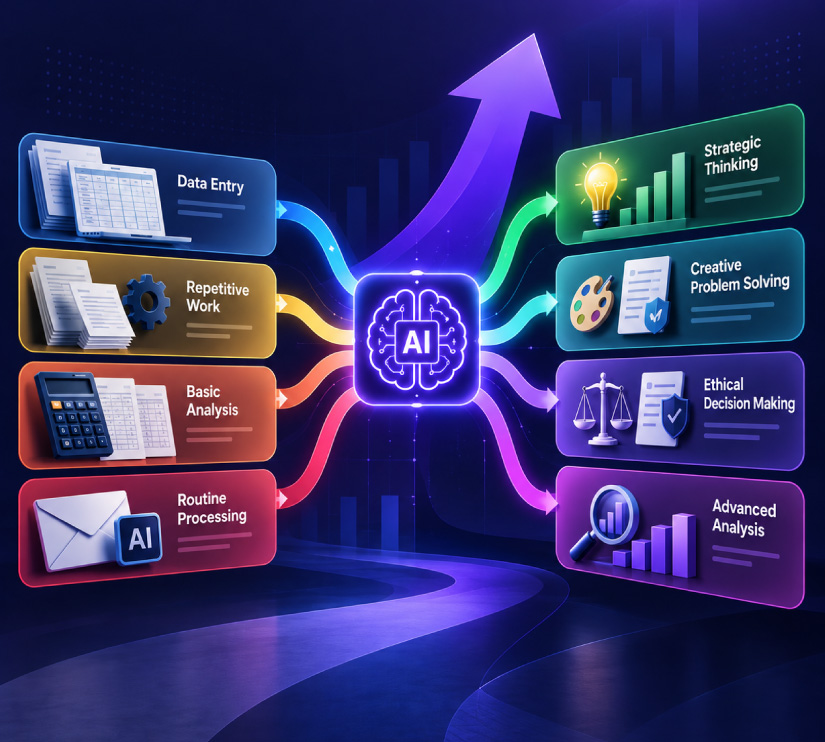
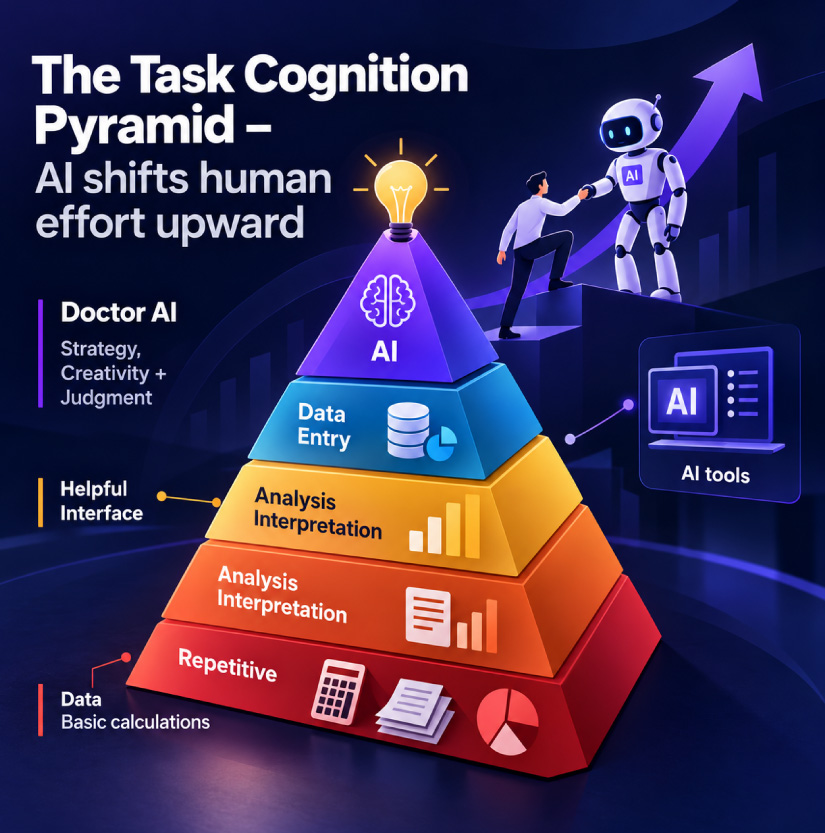
The second key observation that emerged while working with Value Fabric is more fundamental: finance tasks have fundamentally different cognitive natures. A rules-based bank reconciliation is not the same kind of work as interpreting a cash-flow variance or negotiating a board pack narrative. Applying the same tool—or the same expectation of autonomy—to both is the root cause of most failed experiments.
A structured Task Classification Framework is what separates superficial pilots from sustainable value creation. It forces you to look at the work first, then match the right technology to the right cognitive demand.
A Recent Real-World Example
Over the last decade supporting SMEs of roughly CHF 60 million turnover, the pattern is consistent: finance teams are overwhelmed by manual reconciliations, fragmented reporting, ad-hoc analysis, and the dual demand for better liquidity visibility and shorter closing cycles.
Instead of rushing into new tools, we started by classifying and decomposing processes. This simple diagnostic immediately revealed where effort was being wasted and where technology could actually help:

Rules-based tasks
(transaction matching, standard reconciliations, invoice data capture) & ideal candidates for RPA and OCR.

Analytical & predictive tasks
(cash forecasting, variance analysis, anomaly detection) suited to machine-learning models once data quality is addressed.

Judgmental & interpersonal tasks
(final validation, board communication, change management) remain human-led, but can be strongly augmented by AI-generated insights and drafts.

Concrete results from this approach included: a reliable 13-week rolling cash-flow forecast, reduction of the monthly close from M+10 to M+5, construction of a complete fixed-asset register from scratch, and a visible shift of the team from firefighting to higher-value analytical and strategic work. The same task-first method had previously accelerated ERP benefits and process redesign during Shared Service Centre migrations in IT, automotive and FMCG environments.
The Task Classification Framework — Four Practical Steps
The framework is deliberately simple so it can be applied in a half-day workshop and then refined over successive close cycles.
Step 1 — Inventory & Map
List the core processes that consume the team’s time: month-end close, cash management, budgeting & forecasting, audit preparation, risk assessment, accounts payable/receivable, fixed assets, intercompany, etc. For each process, sketch the current flow at a high level (who does what, which systems and spreadsheets are touched, where the bottlenecks and hand-offs sit). Do not yet discuss tools.
Step 2 — Classify by Cognitive Nature
Assign every significant sub-task to one of five categories:
- Rules-based / Repetitive — clear if-then logic, high volume, stable rules (invoice processing, bank matching, data entry, standard reconciliations).
- Research-intensive — document-heavy work that requires extraction, matching and compliance checking (audit evidence, contract review, regulatory research).
- Analytical / Predictive — pattern recognition, forecasting, anomaly detection, variance analysis, unit economics.
- Creative / Judgmental — scenario design, risk interpretation, strategic narrative, assumption challenging.
- Coordinative / Interpersonal — cross-functional alignment, board reporting, stakeholder communication, change management.
Step 3 — Decompose, Prioritise & Match Tools
Break each process into its subtasks and rank them by (a) volume of effort, (b) error risk, and (c) value of freeing capacity. Prioritise non-value-added, high-volume rules-based work first—these deliver the quickest credibility wins. Only then select technology that matches the cognitive profile (see the practical matrix in the Appendix). Typical pairings include BlackLine / FloQast / HighRadius for close & reconciliations, Kyriba or Agicap for treasury forecasting, DataSnipper or Trullion for audit evidence, and governed generative AI (Claude, ChatGPT Enterprise, or platform copilots) for narrative and scenario work.
Step 4 — Implement, Measure & Iterate
Deploy in small, measurable increments. Pair every technology change with explicit change-management actions: role redesign, training, new control points, and a simple feedback loop after each close. Track both hard metrics (close days, forecast accuracy, auto-match rates) and soft ones (time spent on analysis versus data preparation, team engagement). Adjust classification and tool choices as processes and data quality evolve.
Why This Framework Works
The approach is not theoretical. It aligns with established industry research and with the practical reality of how finance work is actually performed:
- Gartner and other analyst firms consistently show that automation potential varies sharply across finance activities. Routine, structured tasks are highly automatable; complex judgment and external communication remain human-led.
- Intelligent Process Automation (IPA) studies (KPMG and others) demonstrate that combining RPA with AI/ML delivers substantially better outcomes than RPA alone—precisely because different cognitive demands require different technical approaches.
- Cognitive task analysis research underlines the value of decomposing work according to its intellectual demands so that technology augments rather than inappropriately replaces human strengths.
By respecting how the work actually operates, the method produces quick, visible wins that build momentum, reduces resistance to change, and keeps AI in its proper role: augmenting decision-making rather than pretending to replace it.
Benefits for Finance Leaders and Teams
Productivity without forced headcount reduction
Capacity is redirected to analysis, control and strategy.
Better risk management and more accurate forecasting
Once data quality and model governance are addressed.
Higher team engagement
Professionals move from repetitive preparation to higher-value interpretation and communication.
Scalability
The same classification logic works for a 30-person finance team in an SME and for a multi-country shared-service organisation.
From Hype to Competitive Advantage
In a fast-moving environment, finance leaders cannot afford inefficient AI experiments. A methodological, task-first approach converts technology from a cost centre driven by vendor hype into a genuine competitive advantage. The Appendix that follows turns the five cognitive categories into a practical diagnostic matrix you can use in your next process review.
What about you? What challenges have you faced when applying AI in your finance function? Have you classified tasks by cognitive type before selecting tools? Share your experience—practical lessons are more valuable than theoretical frameworks.
Ready to make cash visibility your new competitive edge?
Book a no-obligation 30-minute diagnostic call and I’ll help you identify your top 3 priorities and quick wins — at no cost.
Take immediate control
of your financial operations
Do not let cultural friction or regulatory blind spots derail your integration.
Deploy proven interim financial leadership.